If you're a long-time Doom fan, you've probably spent dozens of hours ripping and tearing through hellish hordes in Doom Eternal, and you're likely hyped for the upcoming Doom the Dark Ages release. The debate around Doom Eternal vs Doom the Dark Ages has been blowing up in fan forums ever since the first Dark Ages trailer dropped, with players speculating how the new entry will stack up to the widely beloved 2020 title. I've put over 200 hours into Eternal across multiple difficulty runs, including a full ultra-nightmare playthrough last year, and I've dug through every official gameplay clip, developer interview, and confirmed leak about Dark Ages to break down exactly how the two games compare, so you know what to expect when the new title launches.
Core Gameplay Loops: Doom Eternal vs Doom the Dark Ages
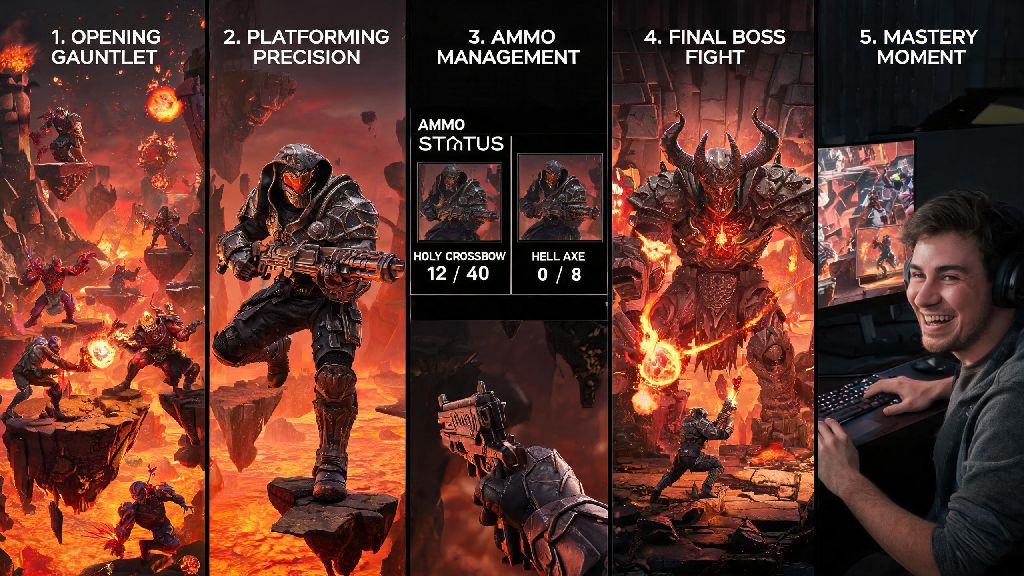
Doom Eternal’s entire design revolves around non-stop, movement-first combat that punishes you harshly for standing still for even a second. You have to chain dashes, double jumps, and wall climbs to avoid enemy attacks, while cycling through glory kills for health, chainsaw takedowns for ammo, and flame belch for armor to keep your resources topped up. Doom Eternal’s gameplay is built around constant resource management that rewards careful enemy prioritization over mindless spraying, making even basic combat encounters feel like fast-paced puzzles you have to solve on the fly. When you stack Doom Eternal vs Doom the Dark Ages side by side, the biggest difference in gameplay is the focus on movement vs close-quarters combat. Dark Ages still keeps the signature fast Doom combat, but it trades a lot of Eternal’s open platforming segments for tight, enclosed medieval corridors and castle battlefields that encourage more up-close fights. Devs have confirmed the glory kill system is returning, but you’ll have far more options to take down enemies with melee attacks instead of relying solely on guns. If you hated Eternal’s frequent platforming sections that broke up combat flow, Dark Ages is likely going to be a much better fit for your playstyle.
Setting and Narrative Tone
Doom Eternal’s story is unapologetically over-the-top, spanning post-apocalyptic Earth, the depths of hell, and the heavenly realm of Urdak as you fight to stop a cosmic invasion led by god-like beings called Maykrs. The Slayer is framed as an unstoppable demigod, with lore that leans into campy, epic spectacle more than grounded emotion. It’s a fun ride, but it never takes itself too seriously, and most of the story beats feel like an excuse to get you to the next big combat arena. Doom the Dark Ages leans heavily into historical horror elements, blending real medieval folklore with classic Doom demonic imagery to create a far grittier, more somber tone. The game is a prequel set in 9th century Europe, long before the Slayer gained his full powers, so you get to see his first encounters with hell’s invasion of Earth. The narrative focuses far more on the human cost of the demonic attacks, with side stories of surviving villagers and knights that add real weight to your fights. I loved Eternal’s silly, over-the-top vibe where you punch a god in the face halfway through the game, but I’m excited to see a more grounded take on the Doom universe that feels higher stakes for regular people caught in the crossfire.
Weapons and Progression Systems
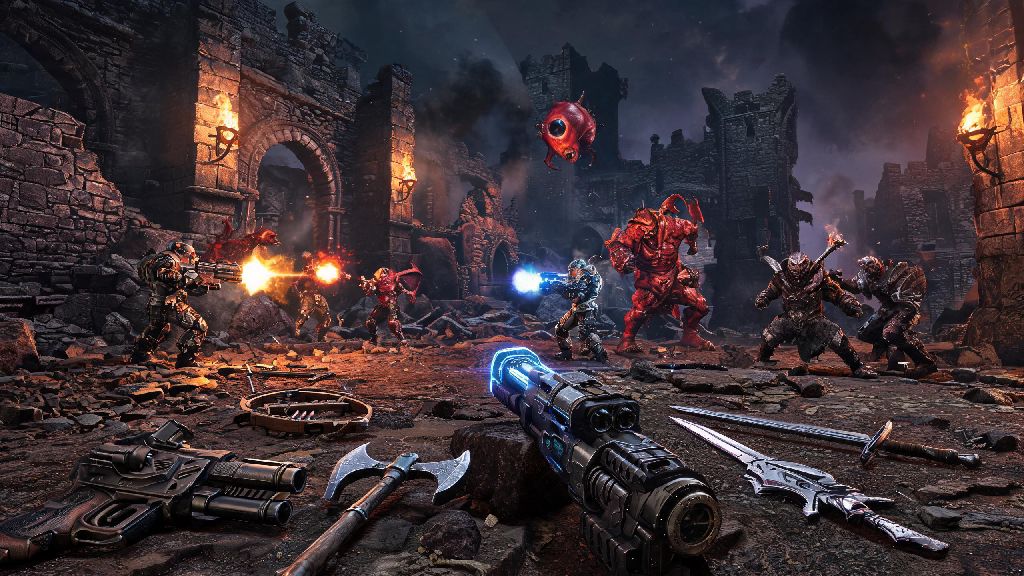
Eternal’s iconic arsenal is built for fast, ranged combat, with every weapon serving a specific purpose against different enemy types. The super shotgun’s meat hook lets you zip across arenas to close gaps, the plasma rifle melts shielded enemies in seconds, and the BFG 9000 is perfect for clearing out entire hordes when you’re overwhelmed. You unlock weapon mods and runes as you progress that let you tweak your playstyle slightly, but the overall progression path is fairly linear, with most upgrades focused on making you more efficient at the existing combat loop. Unlike Eternal, where melee is mostly reserved for glory kills and quick chainsaw takedowns, melee combat is a full core feature in Dark Ages. The dev team has shared that the game will have a mix of reimagined classic Doom weapons and brand new medieval-inspired tools, with far more customization options than Eternal offered.
- Dark Ages features 3 exclusive melee weapons with unique upgrade paths, compared to Eternal's 2 situational melee tools (chainsaw and crucible)
- Classic weapons like the super shotgun are reworked for the medieval setting, with slower reload speeds but higher per-shot damage
- Dark Ages adds environmental weapons you can pick up mid-combat, like battle axes from fallen knights and boiling oil pots, that have no ammo cost but limited durability
- Eternal's weapon mod system is replaced with a socket system in Dark Ages, where you can insert hell-infused runes to change weapon behavior instead of swapping between two fixed mods
Difficulty and Accessibility for New Players
Doom Eternal is infamously unforgiving for new players, even on the lowest standard difficulty setting. The game throws you into the deep end almost immediately, and if you don’t master the resource loop and movement mechanics quickly, you’ll find yourself dying over and over in the first few levels. There’s no mid-level difficulty scaling, so if you get stuck on a boss fight, your only options are to grind out the encounter until you beat it or restart the entire level on a lower difficulty tier. Dark Ages includes a dynamic difficulty scaling system that adjusts enemy spawn rates and damage if you die multiple times in the same section, without forcing you to drop to a lower difficulty tier entirely. The dev team has also shared that they’re adding far more accessibility options than Eternal had, including customizable control schemes for melee combat, colorblind modes tailored to the game’s darker medieval lighting, and an optional extended tutorial that walks you through all core mechanics step by step. Veteran players don't have to worry about the game being too easy, though, as the highest difficulty tier for Dark Ages is confirmed to be even more challenging than Eternal's Nightmare mode, with faster enemies, higher damage, and no checkpoints between major combat encounters.
At the end of the day, both Doom Eternal and Doom the Dark Ages bring the signature fast-paced, rip-and-tear combat that the franchise is famous for, but they cater to slightly different player preferences. If you love over-the-top cosmic action, tight platforming, and a resource loop that feels like a combat puzzle, Eternal is still one of the best FPS games you can play right now. If you prefer darker, more grounded settings, more melee combat options, and a more accessible entry point to the series, Dark Ages is going to be well worth your wait. The conversation around Doom Eternal vs Doom the Dark Ages will only get more heated as we get closer to the Dark Ages release date, but no matter which side you land on, it's a great time to be a Doom fan.